MENU
© 2026 CricDesi Media

Search: "Thala"

Results Found: 4

Category
Sort By
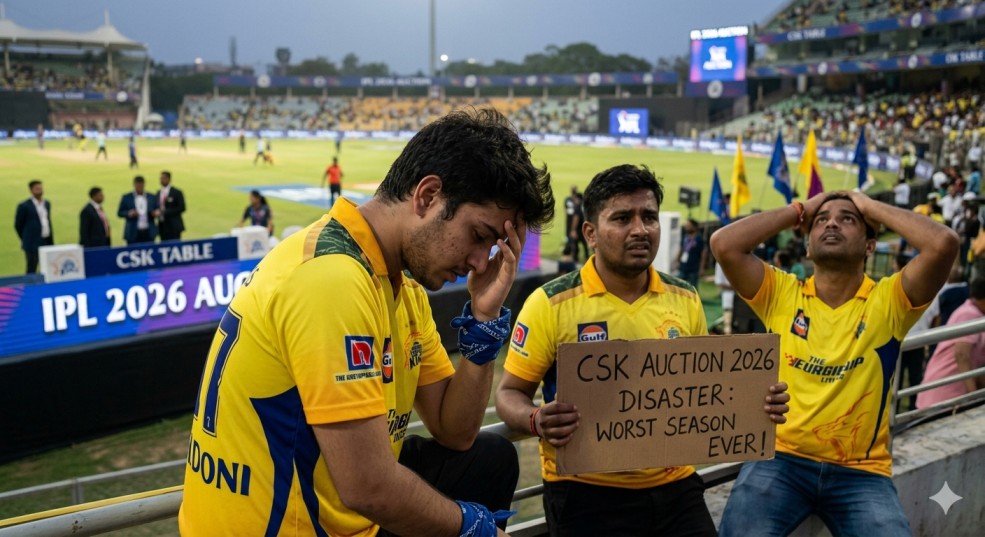
CSK's IPL 2026 Auction Disaster: Worst Season Ever
ipl 2026

CSK's IPL 2026 Auction Disaster: Worst Season Ever

CSK spent ₹100 crore on Sanju Samson and Other Players and also retained MS Dhoni, but sit 5th with just 3 wins in 8 games in IPL 2026. Ruturaj form crisis, Dhoni's injury, and Khaleel absence expose a structurally flawed auction strategy at Chepauk.Chennai Super Kings in IPL 2026 has transitioned from a temporary slump into a full-scale systemic crisis, exposing the structural fragility of a roster that was supposedly built for dominance. The narrative surrounding the most successful franchise in league history has shifted from strategic brilliance to "Auction Disaster" as the team grapples with an identity crisis at the hallowed MA Chidambaram Stadium. Despite a staggering financial outlay, including a record-breaking ₹26 crore acquisition of Sanju Samson and the heavy-emotional retention of an injured MS Dhoni, the squad looks physically exhausted and tactically outdated. In Match 37 against the Gujarat Titans, the cracks in the foundation were laid bare as the top order collapsed to a humiliating 37/4, eventually laboring to reach fifty runs in 11.6 overs—one of the slowest collective performances in the history of the modern game.Match 37: The "Slowest Fifty" BreakdownMetricStatisticHistorical ContextGaikwad's Fifty49 BallsSlowest in IPL since 2019Team 50 Mark11.6 Overs2nd Slowest for CSK in historyBoundary Drought35 BallsLongest streak in IPL 2026Powerplay Result28/3Structural failure against RabadaThe emotional toll of this decline is most visible in the form of Ruturaj Gaikwad, whose captaincy seems to have sapped the natural fluency from his blade. Facing a season where he has already accumulated over 50 dot balls, Gaikwad’s struggle to find his rhythm has created a vacuum at the top of the order that even the expensive acquisitions cannot fill. With the middle order offering zero meaningful contribution and the bowling unit looking toothless following the injury to Khaleel Ahmed, the "Chepauk Fortress" has officially been breached. For a journalist observing the technical breakdown, the irony is impossible to ignore; CSK possesses one of the most expensive rosters in the 100-plus crore era, yet they are currently being outpaced by younger, leaner units that prioritize high-velocity intent over legacy and reputation.CSK Disaster Metrics: Season 2026MetricStatisticHome Win %40% (Chepauk is no longer a fortress)Death Bowling Econ12.4 (Worst in the league post-Khaleel injury)Samson Avg (2026)22.4 (For a ₹18Cr investment)Dots Faced (Total)65 (In Match 37 alone)As the tournament moves toward the business end, the primary question for the Chennai management is whether their 2026 auction strategy was an expensive mistake that neglected the raw fundamentals of T20 balance. The reliance on a half-fit legendary keeper and an out-of-form captain has left the team's playoff hopes hanging by a thread, with five losses in seven matches relegating them to the bottom half of the table. For the readers at CricDesi, the sight of a ₹26 crore Samson failing to stabilize the ship while the Titans comfortably chased down a sub-par total serves as a somber lesson in team building. In the high-velocity world of IPL 2026, money can buy stars, but it cannot buy the technical discipline and hunger that once made Chennai the most feared unit in the country.Ultimately, the failure to secure a reliable death-bowling alternative or a high-intent opening partner for Ruturaj has exposed the Super Kings to the ruthless efficiency of clinical chasers like Gujarat. The 2026 season has evolved into a sprint where intent is the only currency that matters. The historical weight of their five trophies feels more like an anchor than a sail, dragging the franchise down as they struggle to adapt to a landscape where 200 is no longer a safe score, and Chepauk is no longer a guaranteed two points. Unless a radical tactical shift occurs in the coming week, the "CSK Auction Disaster" will be cited for years as the moment the most iconic franchise in the league finally lost its way.The technicalities of Chennai’s ₹100-plus crore roster are currently facing a harsh reality check, as the 2026 season exposes the risks of a legacy-heavy auction strategy. The narrative is no longer about "thala" magic, but about a squad that appears structurally disconnected from the high-velocity demands of modern T20 cricket. The ₹18 crore trade for Sanju Samson (part of a massive deal involving Ravindra Jadeja and Sam Curran) was intended to solve the long-term wicketkeeping and middle-order puzzle. However, Samson’s struggle to anchor the ship—highlighted by his 11 off 15 in the recent collapse—suggests that even the most expensive stars are struggling to thrive in a system currently devoid of batting momentum.The emotional anchor of the franchise, MS Dhoni, remains sidelined due to a persistent calf injury, which head coach Stephen Fleming recently confirmed was aggravated during a warm-up game. This absence has left a leadership and finishing vacuum that the current roster is failing to fill. Compounding the misery is the loss of Khaleel Ahmed, who has been officially ruled out of IPL 2026 following quadriceps surgery. Without their primary left-arm pace threat and with Ruturaj Gaikwad enduring a strike-rate crisis, the "Auction Disaster" tag is becoming harder to refute. For the readers at CricDesi, the current state of CSK is a cautionary tale: in the 2026 era of 200-plus par scores, relying on a "safety-first" anchor and injured legends is a recipe for a mid-table exit.
Apr 27, 2026 Harshvardhan Singh Gaur
MS Dhoni IPL 2026 Return:Will Thala Play vs MI at Wankhede
ipl 2026

MS Dhoni IPL 2026 Return:Will Thala Play vs MI at Wankhede

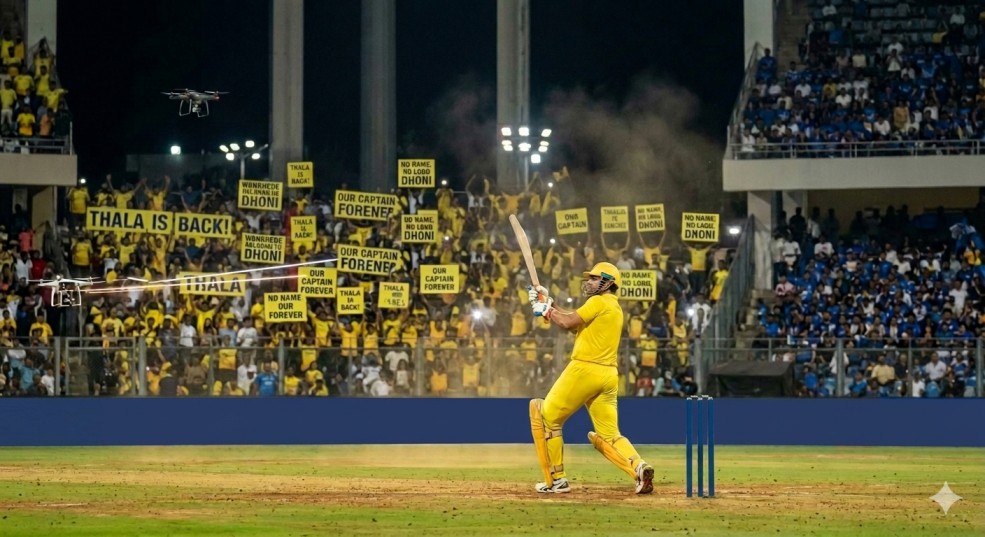
MS Dhoni trained for 40 mins wicketkeeping and 1 hour batting at Wankhede on April 21.The anticipation surrounding the potential return of Mahendra Singh Dhoni has reached a fever pitch as the Chennai Super Kings prepare for their high-stakes encounter against the Mumbai Indians at the Wankhede Stadium. After missing the first six matches of the IPL 2026 season due to a persistent calf strain, the sight of the 44-year-old legend grueling through a rigorous practice session on April 21 has sent shockwaves of excitement through the cricketing community. Eyewitness reports from the Wankhede nets describe a vintage Dhoni, who spent 40 minutes sharpening his wicketkeeping reflexes before transitioning into a full hour of high-intensity batting practice. Most importantly, he appeared to move without any visible signs of discomfort, suggesting that the rehabilitation process following his offseason surgery and the recent muscle injury has finally reached its culmination.IPL 2026: Match 33 Preview & CSK Season Stats Match Summary: MI vs CSK CategoryMatch DetailsDate & TimeApril 23, 2026VenueWankhede Stadium, MumbaiCurrent StatusMS Dhoni cleared to play (fitness test passed)Head-to-HeadMI 20 - 17 CSK (Overall)Dhoni’s return is as much about respect as it is about physical fitness, with the CSK management reportedly leaving the final decision entirely to the man himself. This "player-first" approach is a testament to the unparalleled legacy Dhoni has built over nearly two decades, where his tactical acumen remains as vital to the Yellow Army as his finishing prowess. For a player who has redefined the role of a finisher in T20 cricket, the prospect of his debut in the 2026 edition of the IPL is not just a tactical boost for Chennai but a massive emotional lift for a tournament that thrives on his presence. The Wankhede Stadium, historically a second home for Dhoni ever since the 2011 World Cup triumph, is expected to be a sea of yellow on April 23, as fans from across the country descend upon Mumbai for what could be the most significant comeback story of the year.The stakes for this match extend beyond individual milestones, as the Mumbai Indians and Chennai Super Kings are both navigating a turbulent mid-season phase where every point is critical for playoff qualification. While Chennai has managed to stay afloat in his absence, the lack of a stabilizing lower-order force has been evident in their narrow losses. Dhoni’s return would not only bolster their batting depth but also provide Ruturaj Gaikwad with the on-field mentorship that has become a hallmark of the CSK leadership transition. As the 44-year-old prepares to step onto the hallowed turf once more, the question is no longer just about his fitness but about the impact he can still have on a game that continues to evolve at a breakneck pace. For the fans at CricDesi and beyond, the message is clear: the wait is nearly over, and the stage is set for Thala to write another chapter in his legendary career.Beyond the headlines, the medical specifics of Dhoni's recovery have been a closely guarded secret, but the intensity of his recent training sessions indicates a player who is not merely looking to participate but to compete at the highest level. The calf strain, which initially kept him out for 25 days, required a meticulous recovery plan to ensure that the 44-year-old's body could handle the rigors of standing behind the stumps for 20 overs. His ability to bat for an hour against both pace and spin in the nets without any restricted movement is the clearest indicator yet that the CSK medical team has cleared the path for his inclusion. As the sun sets over the Arabian Sea and the lights of the Wankhede flicker to life, all eyes will be on the team sheet, waiting for the one name that turns a cricket match into a historic event.The medical consensus following MS Dhoni’s intensive training stint at the Wankhede is that the legendary finisher is on the verge of making his first appearance in the 2026 season. After 21 days of meticulous rehabilitation for a calf strain, the 44-year-old’s Tuesday night session was the ultimate litmus test. Dhoni wasn't just participating; he was commanding the space, spending 30 minutes behind the stumps to sharpen his reflexes while keeping for Mumbai’s own Sarfaraz Khan against the spinners. His agility during these wicketkeeping drills, including several sharp, "blink-and-you-miss-it" stumping attempts, suggests that the restricted movement caused by the muscle strain has been largely resolved.Facing a barrage from the likes of Matt Henry and Jamie Overton, Dhoni initially took a few balls to find his timing before switching into "beast mode." Observers noted that his lofted shots, particularly those aimed between long-on and mid-wicket, carried the same effortless power that has haunted bowlers for decades. He even cleared the sightscreen with a couple of perfectly timed straight drives, a clear indicator that his base remains as strong as ever despite the layoff. The fact that he was comfortable enough to engage in light-hearted banter with the cameraman after such a grueling session speaks volumes about his mental frame of mind—relaxed, focused, and ready for the grandest stage.As the "El Clásico" of IPL 2026 looms, the decision remains a personal one for Dhoni. With the CSK management having given him the green light to dictate his own comeback, the Wankhede crowd on April 23 is prepared for a "Thala" entrance that could redefine the term "home away from home." For a Chennai side that has occasionally looked adrift in the lower-middle order, Dhoni’s return isn't just about the runs he might score; it's about the tactical weight he brings to the field. If he steps out on Thursday night, it will mark the end of one of the most talked-about injury layoffs in recent history and the beginning of what many hope will be a vintage late-season surge for the five-time champions.Founder's Tip: Highlight the "101 vs 100" stat from yesterday's MI game to remind your readers that while the veterans (Dhoni/Rohit) are away, the youngsters (Tilak Varma) are rewriting the rules.

Apr 22, 2026 Harshvardhan Singh Gaur
₹18 Crore, 3 Games, 3 Failures. What Is Going Wrong for Sanju Samson at CSK?
ipl 2026

₹18 Crore, 3 Games, 3 Failures. What Is Going Wrong for Sanju Samson at CSK?

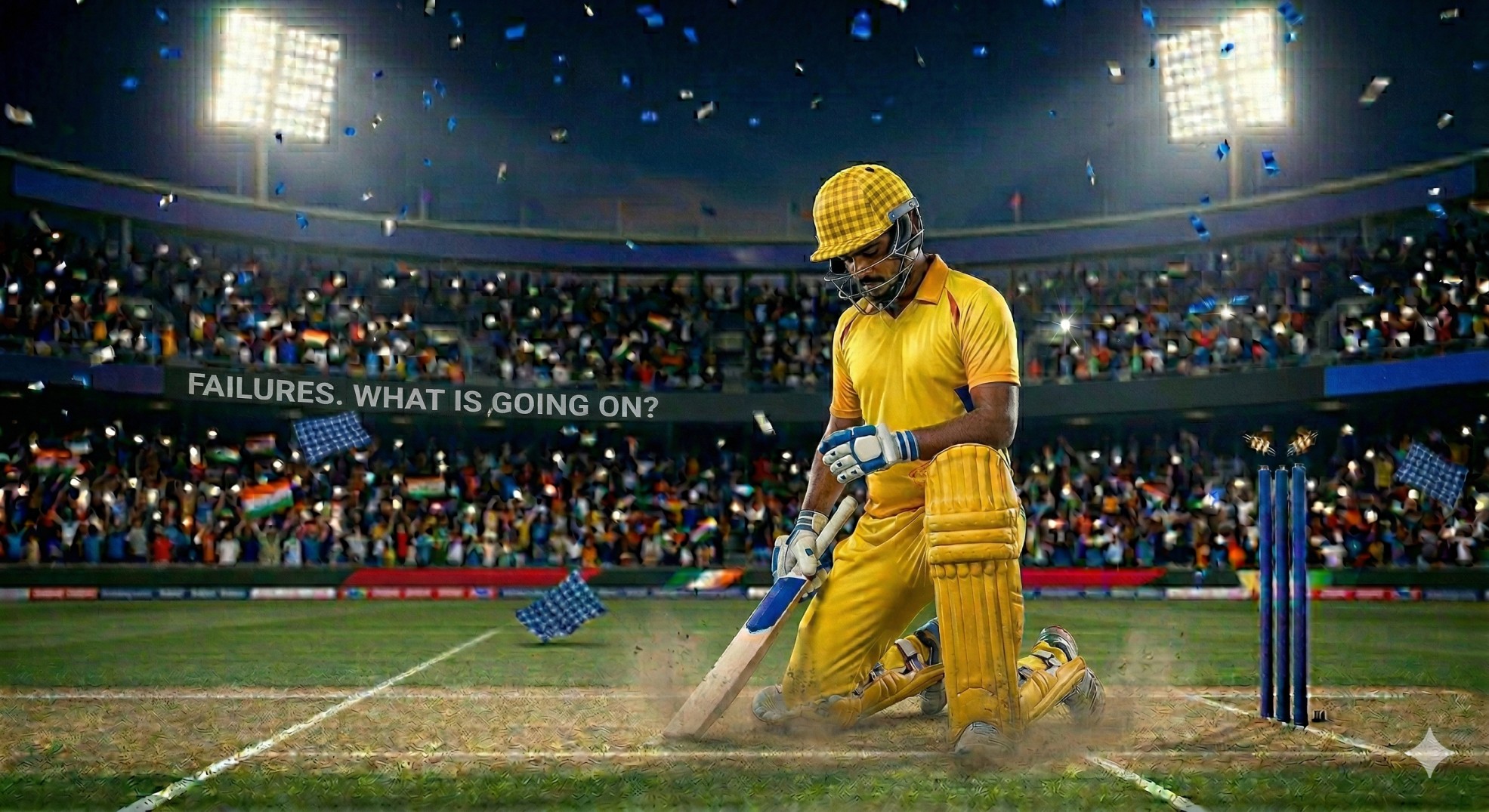
From Player of the Tournament in the T20 World Cup to a 0–3 nightmare in yellow, Sanju Samson, CSK’s blockbuster ₹18 crore trade, is under pressure after failing for the third consecutive time in IPL 2026. After scoring just 6 and 7 in his first two outings, the "New Thala" fell for another single-digit score (9 off 5) against RCB at the Chinnaswamy.There’s a certain weight that comes with a big price tag in the Indian Premier League. It doesn’t just follow a player into the auction room; it follows him onto the field, into every inning, into every shot he plays or doesn’t play. For Sanju Samson, that weight seems to be getting heavier with each passing game in IPL 2026. Three matches, three underwhelming performances, and suddenly the conversation is no longer about potential or flair—it's about pressure, expectations, and a growing sense of uncertainty around his role in Chennai Super Kings.What has happened so far is not dramatic, but it is consistent in the worst possible way. Samson hasn’t completely failed in the sense of reckless dismissals or obvious technical flaws. Instead, his innings have been strangely incomplete. Starts without finishes, intent without impact, presence without influence. It’s the kind of form that is harder to diagnose because nothing looks obviously broken, yet nothing seems to work. In a format as unforgiving as T20, occupying that middle ground can often be the most perilous position.There’s also the context of the team around him. CSK, a side known for stability and clarity, suddenly looks like they are searching for answers. Their batting hasn’t flowed the way it usually does. Their middlemen lack the control that once defined them. And into this environment steps a player like Samson, who thrives on rhythm and confidence. Instead of finding a structure that supports him, he finds himself in a lineup that is itself trying to rediscover its balance.Why is this happening, though? Why does a player with Samson’s talent and experience look so out of sync? The answer is not simple, but it starts with timing—not just in terms of shot selection, but in terms of decision-making. Samson has always been a player who relies on instinct. When he is in form, that instinct looks effortless, almost natural. When he is not, he can appear hesitant. And hesitation, even for a fraction of a second, is enough to disrupt rhythm in T20 cricket.There’s also the question of role clarity. In previous setups, Samson often had a clearly defined position — a phase of the innings where he could express himself without overthinking. At CSK, that clarity seems less obvious. Is he expected to anchor? To accelerate? To finish? These are not just tactical questions; they influence how a player approaches each ball. Without clear answers, even experienced players can find themselves caught between aggression and caution.Another layer to this situation is the pressure of expectation. An ₹18 crore price tag doesn’t just reflect a player’s ability; it amplifies it. Every inning is viewed through that lens. Every failure feels larger, more significant. And while professional players are trained to handle pressure, there’s a difference between handling it and being constantly defined by it. For Samson, the pressure doesn’t just come from the opposition or the conditions; it comes from the narrative building around him.There’s a subtle but important shift that happens when a player is under this kind of scrutiny. Instead of playing the game, he starts managing it. Instead of reacting instinctively, he begins to calculate. And while calculation has its place in cricket, it can also slow things down. Samson’s batting, at its best, is fluid and decisive. Right now, it feels slightly restrained, as if he were trying to avoid mistakes rather than create opportunities.From a tactical perspective, this has consequences for CSK. A player in the middle order who cannot fully express himself creates a gap in the innings. It disrupts momentum, forces other players to adjust, and limits the team’s ability to accelerate when needed. In a format where momentum is everything, even a small disruption can have a cascading effect.What makes this situation more complicated is that there is no obvious solution. You cannot simply drop a player of Samson’s quality after a few games. You cannot ignore his potential or the investment made in him. But you also cannot afford to carry a player who is not contributing consistently, especially in a tournament where every match matters. It’s a delicate balance, one that requires patience but also decisiveness.Looking at the broader picture, this is not just about Samson. It’s about how CSK adapts to a changing format. The IPL of today is faster, more aggressive, and less forgiving than it was even a few years ago. Teams that succeed are the ones that can combine experience with adaptability. CSK has built its legacy on experience, but it now needs to show that it can evolve as well.For Samson, this phase could be defining. Not in the sense that it will determine his career, but in how it shapes his approach moving forward. Every player goes through periods of struggle, but the response to those struggles often defines their trajectory. Does he simplify his game? Does he return to instinct? Or does he continue to search for a balance that remains elusive?There is also an emotional dimension to this narrative. Samson is not just another player; he is someone who has long been associated with potential, with the idea that his best is always just around the corner. That narrative can be both motivating and limiting. It creates expectation, but it also creates impatience. And in a league like the IPL, where time is always short, impatience can quickly turn into pressure.What this development means going forward is uncertain, but it is significant. If Samson finds his rhythm, CSK suddenly looks like a different team. His ability to accelerate, to dominate bowlers, and to change the pace of an innings—these are qualities that can transform matches. But if the current pattern continues, the questions will only grow louder.For CSK, the challenge is to create an environment where players like Samson can succeed. That means clarity of roles, consistency of approach, and perhaps a willingness to adapt strategies to suit individual strengths. It’s not about abandoning what has worked in the past but about recognizing when change is necessary.In the end, this is not a story of failure, at least not yet. It’s a story of uncertainty, of a player and a team trying to find alignment in a format that doesn’t allow much time for adjustment. Samson’s struggles are visible, but they are not irreversible. What matters now is how he responds, how CSK supports him, and how quickly they can turn uncertainty into clarity.Because in the IPL, form can change quickly, narratives can shift overnight, and players who are questioned one week can become match-winners the next. But for that to happen, something needs to click. And right now, for Sanju Samson at Chennai Super Kings, that moment still feels just out of reach.

Apr 10, 2026 Harshvardhan Singh Gaur
CSK vs RCB Match Preview: Pitch Report, Key Players , Playing 11 for IPL 2026 Clash
ipl 2026

CSK vs RCB Match Preview: Pitch Report, Key Players , Playing 11 for IPL 2026 Clash

A Chinnaswamy Without Thala! Can Ruturaj’s CSK survive the Kohli storm in the 2026 Southern Derby?There are matches in the Indian Premier League that feel like routine scheduling, and then there are nights like these—when Royal Challengers Bengaluru hosts Chennai Super Kings at the M. Chinnaswamy Stadium. It’s never just a game in Bengaluru. It’s noise, expectation, pressure, and a strange mix of belief and anxiety that hangs in the air long before the first ball is bowled. And this time, the stakes feel slightly different. Perhaps not higher, but sharper. Both teams are entering this contest with something to prove, even if for very different reasons.Pitch ReportIf there is one ground in India where bowlers go to suffer, it is the M. Chinnaswamy Stadium. The pitch here is as flat as a billiard table, the outfield is lightning quick, and the boundaries—with square boundaries often measuring just 55 to 60 meters and straight boundaries around 65 to 70 meters—are among the shortest in the entire IPL. Add to that the fact that Bengaluru sits at an altitude where the thin air means the ball travels further than it does at sea level, and you have quite possibly the most batter-friendly venue in Indian cricket.What has happened so far this season is not entirely surprising, but it has been revealing. RCB has looked like a team willing to embrace chaos. They haven’t been perfect, but they’ve been bold. They’ve played like a side that understands the nature of their home ground—that if you’re going to win in Bengaluru, you can’t do it cautiously. You have to take risks, sometimes uncomfortable ones, and trust that the conditions will reward your intent. CSK, on the other hand, has looked slightly out of sync. Not weak, not outplayed, but just a fraction off their usual rhythm. And for a team built on precision and control, being slightly off can feel like being completely out of place.RCB vs CSK: Predicted Playing XIsRoyal Challengers Bengaluru are expected to stick with their winning formula at the Chinnaswamy, led by Rajat Patidar. The legendary Virat Kohli will open alongside the explosive Phil Salt, followed by Devdutt Padikkal at number three. The middle order looks solid with Jitesh Sharma, the finishing power of Tim David, and the all-round skills of Krunal Pandya and Romario Shepherd. Bhuvneshwar Kumar and Jacob Duffy will spearhead the bowling department, with Mangesh Yadav completing a formidable attack.Chennai Super Kings face a massive test without MS Dhoni, with Ruturaj Gaikwad leading the side. Sanju Samson is expected to take the gloves and bat high up, supported by the young Ayush Mhatre and the power-hitting Shivam Dube. The middle order features Sarfaraz Khan and Prashant Veer, while the bowling attack will rely on the pace of Matt Henry, Khaleel Ahmed, and Anshul Kamboj, with the spin magic of Noor Ahmad and Rahul Chahar (likely as an impact player) to control the middle overs.The contrast becomes even more intriguing when you consider the venue. Chinnaswamy is not a ground that tolerates hesitation. It’s small, it’s quick, and it rewards aggression almost immediately. Batters immediately settle, and bowlers usually must start strong. It’s a place where games move fast, and once momentum shifts, it tends to stay shifted. For RCB, this ground is familiar territory. For CSK, it’s a challenge that demands quick adaptation. And that’s where things start to get complicated.Why is this transformation happening, though? Why does RCB look more comfortable in its identity while CSK seems to be searching for theirs? Part of it comes down to evolution. The IPL has changed, and it has changed quickly. Scores are higher, strike rates are more aggressive, and teams are less patient. RCB, by design or by necessity, has leaned into this evolution. They play like a team that expects the game to move quickly and has prepared accordingly. CSK, traditionally, has been more methodical. They build innings, control phases, and finish strong. It’s a strategy that has worked for years, but it requires near-perfect execution. And when that execution slips, even slightly, the game can run away from you.There is also a psychological layer that feels impossible to ignore. RCB at home is not just a team; they are an event. The crowd doesn’t just watch; it participates. Every boundary feels louder, every wicket feels heavier. For the opposition, it can be overwhelming. For RCB, it can be energizing. CSK is one of the few teams that have historically thrived in this environment, thanks to their experience and composure. However, maintaining composure is most straightforward when everything is proceeding as planned. When they’re not, even experienced teams can feel the pressure.This is where leadership, both visible and invisible, becomes crucial. MS Dhoni may not be the official captain anymore, but his presence still shapes how CSK operates. The qualities that have defined CSK’s success include MS Dhoni’s calmness and his ability to slow the game down when it feels like it’s speeding up. But even the best instincts need support from execution. And right now, that execution has been inconsistent. Bowling plans haven’t always worked; batting has lacked the finishing certainty that once felt inevitable, and small moments—dropped catches, missed opportunities—have started to add up.RCB, meanwhile, seems less concerned with perfection and more focused on impact. They understand that at Chinnaswamy, you don’t need to win every phase; you just need to dominate a few. A couple of explosive overs, a quick partnership, a sudden burst of wickets—these are the moments that define matches here. And RCB has shown a willingness to chase those moments, even if it means taking risks that might not always come off.What this match means going forward is significant, not just in terms of points but also in terms of direction. For RCB, a win here would reinforce the idea that they are not just entertaining, but effective. It would suggest that their aggressive approach is not just suited to their home ground but capable of delivering results against strong opposition. For CSK, the implications are more nuanced. A win would feel like a reset, a return to familiar territory. A loss, however, would deepen the sense that they are in a transitional phase—not declining, but adjusting.There is also a broader narrative about how teams respond to pressure. RCB thrives on it, or at least they appear to. CSK traditionally manages it, absorbs it, and then redirects it. But pressure in modern T20 cricket behaves differently. It builds faster, it shifts quicker, and it punishes hesitation more severely. The team that understands this better on the night will likely have the advantage.And then there’s the unpredictability factor, which feels almost inevitable in a match like this. Chinnaswamy has a habit of turning expected outcomes into surprises. A total that looks safe suddenly isn’t. A chase that seems unlikely suddenly feels possible. It’s a ground that doesn’t respect logic for long, and that adds another layer of intrigue to the contest.In the end, this match feels less about who is the better team and more about who adapts better to the moment. RCB aims to embrace the chaos and transform the game into a high-scoring contest that amplifies their strengths. CSK will look to impose structure, to slow things down just enough to regain control. It’s a clash of philosophies as much as it is a clash of teams.Because in the IPL, especially at a venue like Eden Gardens, you don’t always win by being perfect. You win by being decisive. By recognizing the moment and acting on it before it passes. As Bengaluru readies for another night of noise and expectation, the question is not just who will win, but who will better understand the moment.

Apr 10, 2026 Harshvardhan Singh Gaur