₹18 Crore, 3 Games, 3 Failures. What Is Going Wrong for Sanju Samson at CSK?
Harshvardhan Singh Gaur
Apr 10, 2026 • 6 min read
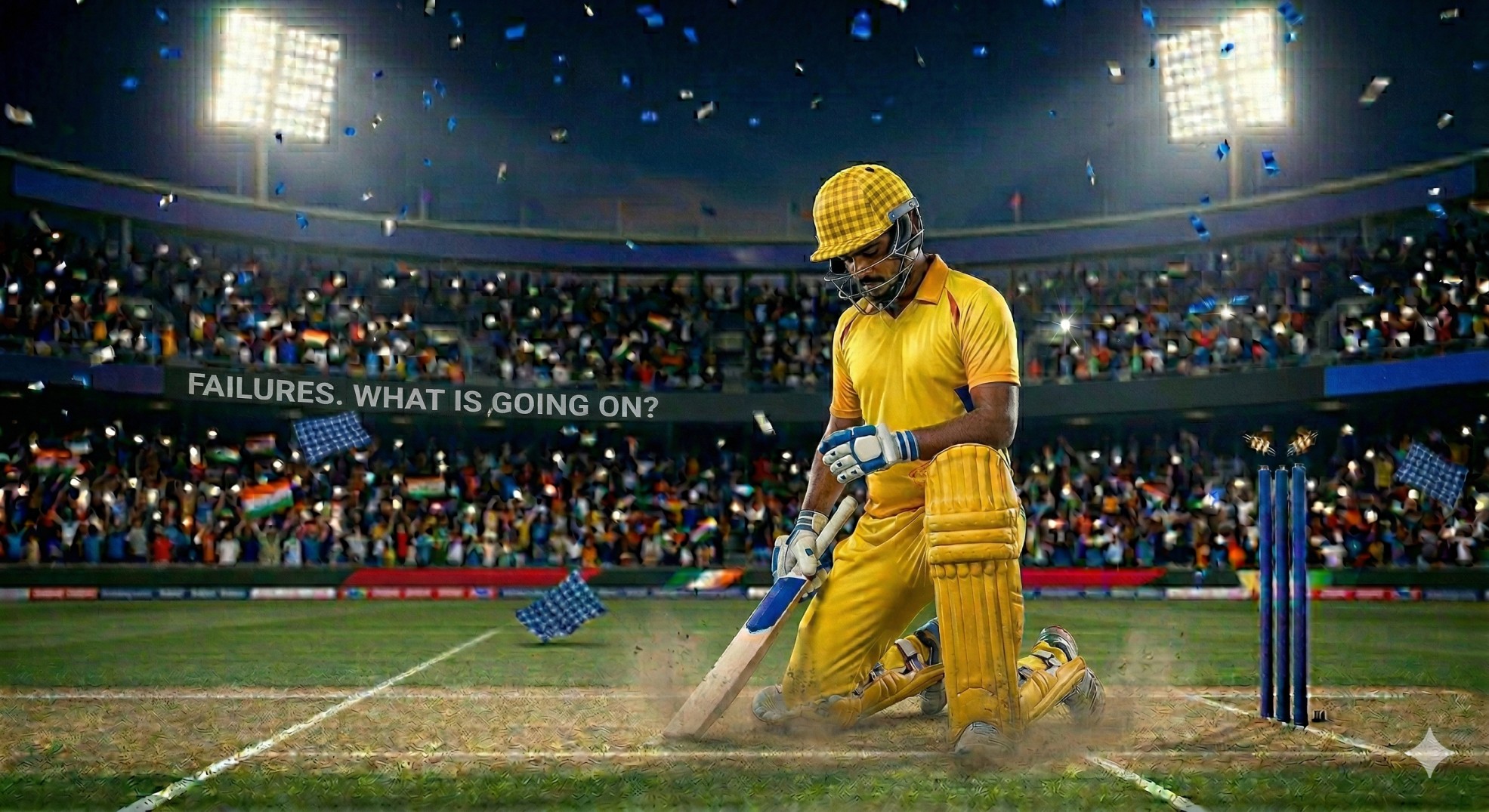
From Player of the Tournament in the T20 World Cup to a 0–3 nightmare in yellow, Sanju Samson, CSK’s blockbuster ₹18 crore trade, is under pressure after failing for the third consecutive time in IPL 2026. After scoring just 6 and 7 in his first two outings, the "New Thala" fell for another single-digit score (9 off 5) against RCB at the Chinnaswamy.
There’s a certain weight that comes with a big price tag in the Indian Premier League. It doesn’t just follow a player into the auction room; it follows him onto the field, into every inning, into every shot he plays or doesn’t play. For Sanju Samson, that weight seems to be getting heavier with each passing game in IPL 2026. Three matches, three underwhelming performances, and suddenly the conversation is no longer about potential or flair—it's about pressure, expectations, and a growing sense of uncertainty around his role in Chennai Super Kings.
What has happened so far is not dramatic, but it is consistent in the worst possible way. Samson hasn’t completely failed in the sense of reckless dismissals or obvious technical flaws. Instead, his innings have been strangely incomplete. Starts without finishes, intent without impact, presence without influence. It’s the kind of form that is harder to diagnose because nothing looks obviously broken, yet nothing seems to work. In a format as unforgiving as T20, occupying that middle ground can often be the most perilous position.
There’s also the context of the team around him. CSK, a side known for stability and clarity, suddenly looks like they are searching for answers. Their batting hasn’t flowed the way it usually does. Their middlemen lack the control that once defined them. And into this environment steps a player like Samson, who thrives on rhythm and confidence. Instead of finding a structure that supports him, he finds himself in a lineup that is itself trying to rediscover its balance.
Why is this happening, though? Why does a player with Samson’s talent and experience look so out of sync? The answer is not simple, but it starts with timing—not just in terms of shot selection, but in terms of decision-making. Samson has always been a player who relies on instinct. When he is in form, that instinct looks effortless, almost natural. When he is not, he can appear hesitant. And hesitation, even for a fraction of a second, is enough to disrupt rhythm in T20 cricket.
There’s also the question of role clarity. In previous setups, Samson often had a clearly defined position — a phase of the innings where he could express himself without overthinking. At CSK, that clarity seems less obvious. Is he expected to anchor? To accelerate? To finish? These are not just tactical questions; they influence how a player approaches each ball. Without clear answers, even experienced players can find themselves caught between aggression and caution.
Another layer to this situation is the pressure of expectation. An ₹18 crore price tag doesn’t just reflect a player’s ability; it amplifies it. Every inning is viewed through that lens. Every failure feels larger, more significant. And while professional players are trained to handle pressure, there’s a difference between handling it and being constantly defined by it. For Samson, the pressure doesn’t just come from the opposition or the conditions; it comes from the narrative building around him.
There’s a subtle but important shift that happens when a player is under this kind of scrutiny. Instead of playing the game, he starts managing it. Instead of reacting instinctively, he begins to calculate. And while calculation has its place in cricket, it can also slow things down. Samson’s batting, at its best, is fluid and decisive. Right now, it feels slightly restrained, as if he were trying to avoid mistakes rather than create opportunities.
From a tactical perspective, this has consequences for CSK. A player in the middle order who cannot fully express himself creates a gap in the innings. It disrupts momentum, forces other players to adjust, and limits the team’s ability to accelerate when needed. In a format where momentum is everything, even a small disruption can have a cascading effect.
What makes this situation more complicated is that there is no obvious solution. You cannot simply drop a player of Samson’s quality after a few games. You cannot ignore his potential or the investment made in him. But you also cannot afford to carry a player who is not contributing consistently, especially in a tournament where every match matters. It’s a delicate balance, one that requires patience but also decisiveness.
Looking at the broader picture, this is not just about Samson. It’s about how CSK adapts to a changing format. The IPL of today is faster, more aggressive, and less forgiving than it was even a few years ago. Teams that succeed are the ones that can combine experience with adaptability. CSK has built its legacy on experience, but it now needs to show that it can evolve as well.
For Samson, this phase could be defining. Not in the sense that it will determine his career, but in how it shapes his approach moving forward. Every player goes through periods of struggle, but the response to those struggles often defines their trajectory. Does he simplify his game? Does he return to instinct? Or does he continue to search for a balance that remains elusive?
There is also an emotional dimension to this narrative. Samson is not just another player; he is someone who has long been associated with potential, with the idea that his best is always just around the corner. That narrative can be both motivating and limiting. It creates expectation, but it also creates impatience. And in a league like the IPL, where time is always short, impatience can quickly turn into pressure.
What this development means going forward is uncertain, but it is significant. If Samson finds his rhythm, CSK suddenly looks like a different team. His ability to accelerate, to dominate bowlers, and to change the pace of an innings—these are qualities that can transform matches. But if the current pattern continues, the questions will only grow louder.
For CSK, the challenge is to create an environment where players like Samson can succeed. That means clarity of roles, consistency of approach, and perhaps a willingness to adapt strategies to suit individual strengths. It’s not about abandoning what has worked in the past but about recognizing when change is necessary.
In the end, this is not a story of failure, at least not yet. It’s a story of uncertainty, of a player and a team trying to find alignment in a format that doesn’t allow much time for adjustment. Samson’s struggles are visible, but they are not irreversible. What matters now is how he responds, how CSK supports him, and how quickly they can turn uncertainty into clarity.
Because in the IPL, form can change quickly, narratives can shift overnight, and players who are questioned one week can become match-winners the next. But for that to happen, something needs to click. And right now, for Sanju Samson at Chennai Super Kings, that moment still feels just out of reach.