Kagiso Rabada: The Destroyer vs MI
Harshvardhan Singh Gaur
Apr 21, 2026 • 6 min read
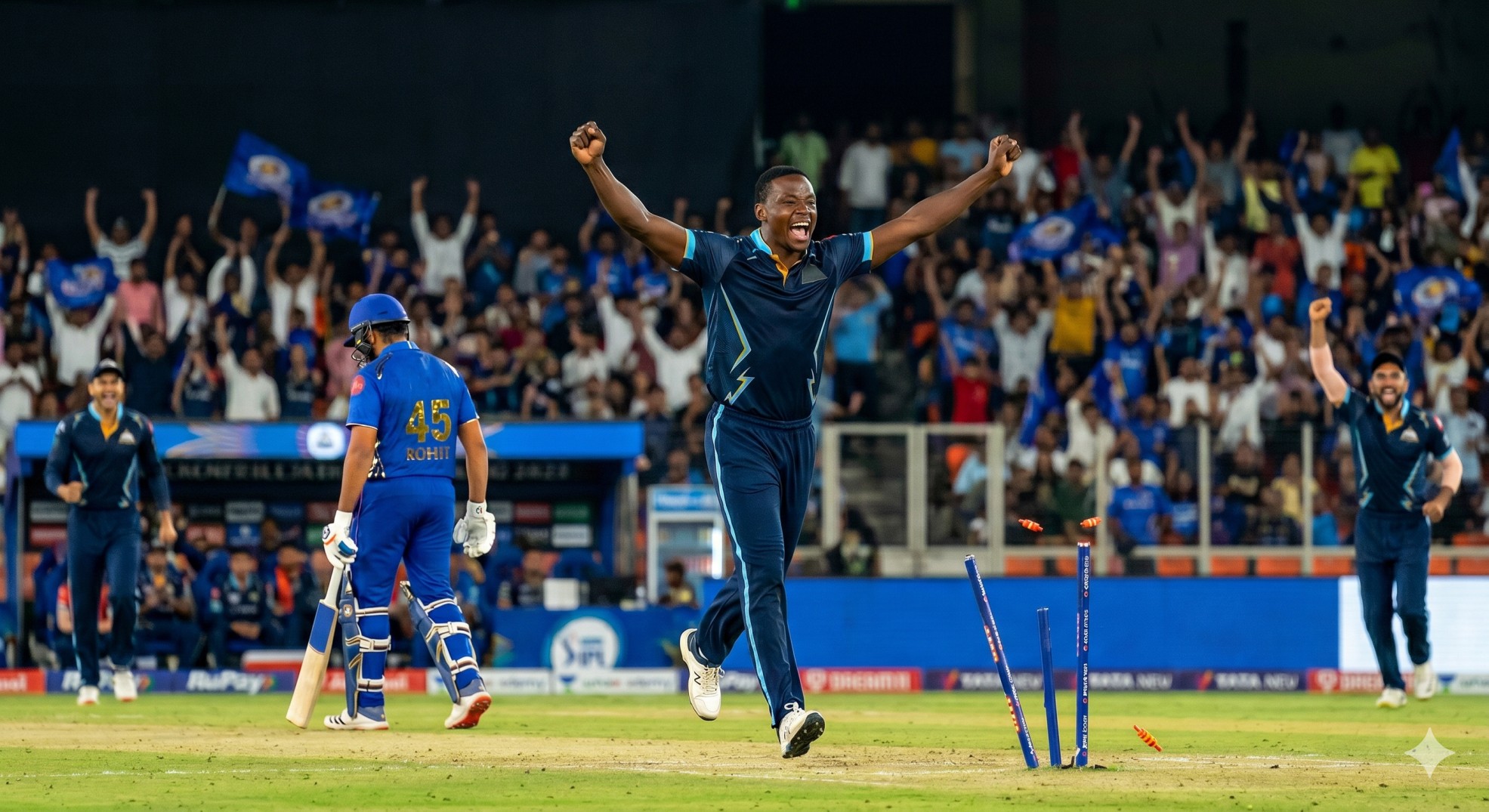
Kagiso Rabada took 3 wickets in powerplay — Malewar, De Kock & SKY — reducing MI to 46/3 vs GT in IPL 2026. But Tilak Varma's 101* ensured Rabada spell was ultimately in vain.
The Narendra Modi Stadium witnessed a masterclass in powerplay bowling that momentarily threatened to push the Mumbai Indians into an abyss, only for the narrative to be completely rewritten by the end of the night. Kagiso Rabada, operating with the kind of hostile intent that has made him a global icon, dismantled the MI top order with a spell of 3/33 that left the visitors reeling at 46/3 within the first six overs. His dismissals were a showcase of pure pace and tactical precision: trapping debutant Danish Malewar for 2, outfoxing Quinton de Kock for 13, and uprooting Suryakumar Yadav’s stumps with a 152.1 kph thunderbolt. For the first hour, it appeared that the Gujarat Titans’ decision to bowl first was a stroke of genius, as Rabada effectively became the leading wicket-taker in the power play for the IPL 2026 season.
IPL 2026: Match Summary & Stats
Match Summary: MI vs GT
| Category | Match Details |
| Venue | Wankhede Stadium, Mumbai |
| MI Score | 199/5 (20 Overs) |
| GT Score | 100 All Out (15.5 Overs) |
| Result | MI won by 99 runs |
| Player of the Match | Tilak Varma (101* off 45) |
However, the beauty of cricket lies in its ability to produce counter-narratives. While Rabada’s initial surge was destructive, it ultimately set the stage for one of the greatest recovery acts in the league’s history. Tilak Varma, entering the fray under immense pressure, navigated the storm with the composure of a veteran before unleashing a late-innings assault that rendered Rabada’s early heroics a mere footnote. Varma’s unbeaten 101 off 45 balls—equalling Sanath Jayasuriya for the fastest century in MI history—shifted the momentum so violently that the Titans never recovered. By the time MI finished at 199/5, the psychological damage was done, proving that in T20 cricket, a brilliant individual spell can be completely overshadowed by a single, perfectly timed gear shift from an elite batter.
Match Performance: Kagiso Rabada (GT)
| Statistic | Figures |
| Overbowled | 4.0 |
| Wickets Taken | 3 (Malewar, De Kock, SKY) |
| Runs Given | 33 |
| Economy Rate | 8.25 |
| Powerplay Impact | 3 Wickets in first 6 overs |
Journalistically, Match 30 was a study in two distinct phases of dominance. Rabada owned the first six overs, but Tilak Varma owned the last fourteen. This 99-run victory for the Mumbai Indians acts as a vital spark for their campaign, while for Gujarat, it serves as a cautionary tale: even the most devastating bowling starts require a middle-order response that never came. As the Titans were bundled out for a meager 100 runs, the scorecard reflected a bizarre reality where Rabada’s fiery opening was the only highlight in a night otherwise defined by total Mumbai dominance.
Match Performance: The Unsung Hero
| Player | Runs | Balls | SR | Impact |
| Naman Dhir | 45 | 32 | 140.62 | Stabilized MI from 46/3 |
| Tilak Varma | 101* | 45 | 224.44 | The Final Explosion |
The tactical duel between Kagiso Rabada and the Mumbai Indians' batting unit in Match 30 was a masterclass in shifting momentum, illustrating why Rabada remains one of the most feared exponents of the new ball in IPL 2026. Heading into this clash, the South African speedster had already established himself as the anchor of the Gujarat Titans' defense, but his performance at the Narendra Modi Stadium took his clinical precision to a new level. By removing Danish Malewar, Quinton de Kock, and the dangerous Suryakumar Yadav in his opening burst, Rabada didn't just take wickets; he dismantled the psychological foundation of the MI top order. His dismissal of SKY, in particular, was a moment of technical perfection—a 152 kph delivery that nipped back just enough to beat the bat and rattle the off-stump, a ball that would have troubled any batter in the history of the league.
Kagiso Rabada: IPL 2026 Season Stats
| Metric | Total |
| Matches | 6 |
| Wickets | 11 |
| Average | 22.40 |
| Strike Rate | 15.81 |
| Economy | 9.73 |
Journalistically, Rabada's spell of 3/33 provides a fascinating statistical anomaly when viewed against the final result. In the first six overs, Rabada was operating at an economy rate of just 5.50, forcing the Mumbai Indians into a defensive shell that usually results in a sub-par total. His ability to hit the "hard length" consistently made it impossible for the MI openers to clear the infield, leading to the desperate shots that eventually caused their downfall. With 10 wickets in 6 matches this season, Rabada is now a frontrunner for the Purple Cap, proving that even in a season dominated by high-scoring totals, a world-class pacer can still dictate the terms of engagement during the powerplay.
However, the "Rabada Factor" was eventually neutralized by a tactical adjustment from Tilak Varma that exposed the Titans' over-reliance on their primary strike bowler. Once Rabada had exhausted three of his four overs, the pressure on the supporting cast—including Rashid Khan and Noor Ahmad—became immense. Varma’s strategy was clear: survive the Rabada storm and exploit the middle-over secondary bowlers. By the time Rabada returned for his final over in the death phase, Varma was already well-set and playing with a strike rate exceeding 200. This shift turned Rabada’s earlier dominance into a distant memory, as Mumbai managed to put up a record-breaking 199/5.
Top Performers of the Match
- Ashwani Kumar (MI): 4/24 (4 Overs) — Career-best figures.
- Jasprit Bumrah (MI): 1/15 (3 Overs) — First wicket of IPL 2026.
- Kagiso Rabada (GT): 3/33 (4 Overs) — Only bowler with economy < 8.00.
For the Gujarat Titans, the primary takeaway from this 99-run defeat is the need for a "Plan B" when Rabada’s early breakthroughs aren't supported by the rest of the attack. While Rabada finished with respectable figures, the fact that the team was bundled out for 100 runs suggests a systemic failure in capitalizing on the platform he provided. As a journalist covering the league, it’s evident that while Rabada can win you the first six overs, the remaining fourteen require a collective resilience that GT currently lacks. As MI celebrates a season-reviving win, Rabada will likely look back at this match as a personal triumph that was ultimately betrayed by a lack of clinical execution from his teammates.
Founder's Question
"Kagiso Rabada was the only GT bowler to stay under 9 RPO while taking 3 top-order wickets. As a founder, do you think GT is becoming too 'Rabada-dependent,' or did the rest of the attack simply fail to capitalize on the 46/3 platform he provided?"