Arshdeep Singh 100 IPL Wickets: 1st for PBKS, Fastest Left-Armer
Harshvardhan Singh Gaur
Apr 17, 2026 • 6 min read
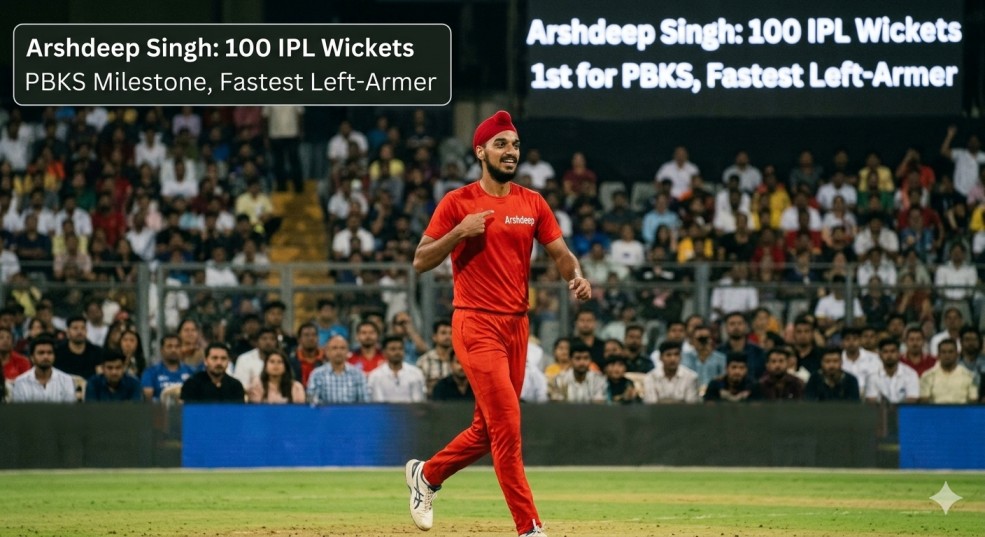
Arshdeep Singh Wicket Record: PBKS Pacer Reaches 100 IPL Wickets Milestone in Win Over Mumbai Indians.
Arshdeep Singh walked in to bowl with calm focus, but what followed in those first few deliveries changed the narrative of the match. Facing the Mumbai Indians at Wankhede is never simple, especially when the pitch offers runs, and the crowd is fully behind the home side. But Arshdeep didn’t look overwhelmed. He looked ready.
The moment arrived early. A slightly back-of-length delivery angled across the batter, inviting the shot. Rickelton went for it, trying to punch it through the off-side, but the ball took the edge and flew straight into the safe hands of the fielder. The celebration was controlled, but the significance was massive.
No dramatic jump, no roar—just a quiet acknowledgment of a milestone that had been built over years of consistency. Arshdeep Singh became the first bowler in Punjab Kings history to reach 100 IPL wickets, and he did it in style—by striking with his very first impact of the match.
In his next spell, when the Mumbai Indians were looking to rebuild, Arshdeep came back with purpose. The field was set, the plan was clear, and the execution was precise. A fuller delivery swung just enough, and Suryakumar Yadav, trying to guide it into the gap, ended up miscuing it. The ball went straight to the fielder.
This wasn’t just about pace. It was about control. Arshdeep mixed his lengths intelligently, used variations when needed, and never allowed the batters to settle. One ball would hold slightly; the next would skid on. One would be angled across; the next would come back in. It was not flashy bowling—it was smart bowling.
Arshdeep Singh: MI vs PBKS Match Stats (16 April 2026)
| Overs | Maidens | Runs | Wickets | Economy |
| 4.0 | 0 | 22 | 3 | 5.50 |
Key Wickets: Ryan Rickelton, Suryakumar Yadav, Sherfane Rutherford
Throughout his spell, Arshdeep maintained tight lines, forcing the batters to take risks. His final figures—3 for 22 in 4 overs with an economy of 5.50—tell the story of dominance. In a format where bowlers often go for runs, controlling the game like this is not easy.
Arshdeep Singh has officially cemented his legacy as the backbone of the Punjab Kings (PBKS) bowling attack. In the 2026 clash against the Mumbai Indians at the Wankhede Stadium, the left-arm pacer achieved a historic milestone by becoming the first-ever bowler to take 100 IPL wickets for the Punjab franchise.
His performance in this match was nothing short of clinical. Finishing with figures of 3/22 in 4 overs, Arshdeep dismantled MI’s top order by dismissing Ryan Rickelton and the dangerous Suryakumar Yadav in a fiery opening spell. Known for his "ice-cold" temperament, he used his signature yorkers and deceptive slower balls to stifle the scoring rate, finishing with an incredible economy of 5.50 in a high-scoring game.
Since his debut, Arshdeep has evolved from a domestic talent into a global T20 specialist. He is now the fastest Indian left-arm pacer to reach the 100-wicket mark in the IPL, joining an elite club featuring legends like Zaheer Khan and Ashish Nehra. His ability to swing the new ball and remain impenetrable at the death makes him Punjab's most prized asset. For fans and critics alike, this 100-wicket milestone isn't just a number—it’s a testament to his consistency and his rise as India's premier T20 strike bowler.
For the Mumbai Indians, these breakthroughs came at the worst possible moments. Just when they were trying to build partnerships, Arshdeep struck. Just when they looked like they might accelerate, he pulled things back.
While the batters later put up a strong total, those early wickets ensured that the score never became completely out of reach. They kept Punjab Kings in the game, they kept the pressure alive, and they set the stage for what was to come.
Belief built by moments like Arshdeep’s spell. And then came the chase. While Prabhsimran Singh exploded at the top with a brilliant 80, and Shreyas Iyer calmly finished things with an unbeaten 66, the foundation of the win had already been laid.
They are built through years of effort, consistency, and understanding of the game. From his early days to becoming the leader of Punjab’s bowling attack, Arshdeep has grown into a dependable match-winner. He doesn’t rely on raw pace alone. He relies on awareness. On execution. On timing. And performances like this prove why he is so valuable.
For the Punjab Kings, this victory was more than just another win. It was their fifth consecutive win, keeping them unbeaten in IPL 2026. And with players stepping up in every department—bowling, batting, leadership—they are quickly becoming one of the most dangerous teams in the tournament.
For the Mumbai Indians, this was another tough outing. Despite putting up a competitive total, they couldn’t stop the momentum once it shifted. And that shift began early—with Arshdeep’s wickets.
This wasn’t a quiet match in the middle of the tournament with nothing at stake. This was a high-pressure clash at Wankhede, against a team like the Mumbai Indians, where even a single over can change the direction of the game. And yet, Arshdeep made it look routine.
There was a moment later in his spell when the Mumbai Indians were trying to rebuild. The batters had just found a couple of boundaries, and the crowd started to believe again. That’s when Arshdeep came back. A slower delivery, perfectly disguised, forced the batter into an early shot. The timing was off, the connection wasn’t clean, and the ball went straight to the fielder.
That’s the sign of a bowler who understands not just how to bowl, but when to bowl. His ability to read the game situation stood out throughout. He didn’t chase wickets blindly. He built them. He created pressure, forced mistakes, and then capitalized. Every over he bowled had a purpose; every delivery had a plan. And perhaps that’s why this milestone feels so earned.
It’s built on consistency. On discipline. On delivering again and again when the team needs it most. And performances like this don’t just win matches—they define careers.